
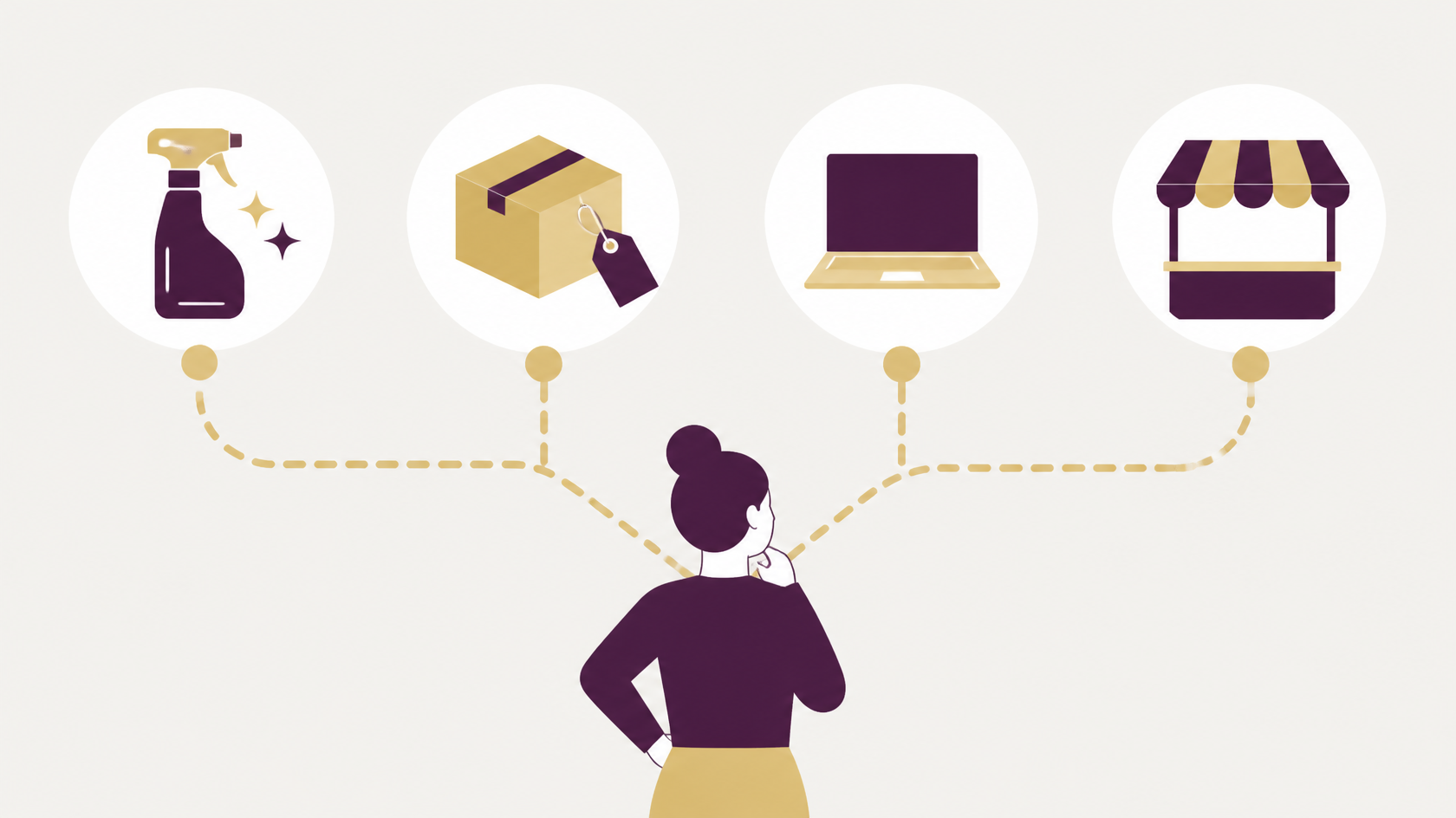
There are four broad families of low-capital business. Each has a different cash profile, risk level and skill requirement. Pick the family that matches your constraints, not the one that looks most exciting online.
1. Services
You sell time and skill: cleaning, repairs, tutoring, admin, design. Startup cost is low because the main investment is tools. Cash arrives quickly and there is no stock to lose. The limit is your calendar, so the goal is to raise your hourly value or build a small team.
2. Resale and arbitrage
You buy low and sell higher: second-hand goods, liquidation stock, niche products. Startup cost equals inventory, and profit is realised only when the item sells. Good for people who enjoy hunting, negotiating and photographing products. Risk: dead stock and platform fees.
3. Digital products and online services
Templates, guides, courses, social media management, editing. Startup cost can be almost zero, and one asset can sell many times. The trade-off is that distribution is hard: without an audience or a clear niche, nobody finds the product.
4. Local physical concepts
Food stalls, event services, rentals, workshops. These have the highest setup cost and the most regulation, but also strong local demand and word of mouth. With €500 you can usually test a single stall, a rental add-on or a one-day workshop rather than a permanent venue.
How to decide
Score each family from 1 to 5 on: skills fit, speed to first sale, startup cost, regulatory burden, and repeatability. The winner is rarely the most glamorous option; it is the one you can actually start this month and deliver reliably.
 English
 French
 Spanish